CurtisJ  ·  Meat Jun: Hawaii's Korean-Hawaiian Comfort Food
Meat Jun: Hawaii's Korean-Hawaiian Comfort Food
Photographed in CurtisJ’s Honolulu kitchen · April 2026

Recipe · Island Comfort

Meat Jun: Hawaii's Korean-Hawaiian Comfort Food

Jump to recipe ↓

Meat jun is Hawaii's egg-battered pan-fried marinated beef: the Korean-Hawaiian plate lunch protein you mostly find only in the islands.

Before you cook

Meat jun is Hawaii Korean food, not Korean food in Hawaii.

You will not find meat jun on the menu in Seoul. You will find it at every Hawaii Korean BBQ drive-in, from Gina's to Sorabol to the small family-run spots that know exactly how thin the beef should be and how lightly the egg should coat. Meat jun is the dish Korean families in Hawaii built to fit the plate lunch format, and it stayed local.

Korean families started arriving in Hawaii in 1903 as sugar-plantation labor, and by the 1960s and 70s Korean food was part of the local plate lunch rotation alongside Japanese, Chinese, Filipino, and Portuguese traditions. The plate-lunch logic (one hot protein over rice, cold mac salad, portable, satisfying) shaped how Korean home cooks adapted their recipes. Bulgogi was too messy for a takeout box. Kalbi worked but needed a bone. Meat jun, paper-thin beef, egg-coated, pan-fried in a single layer, fit the format and became the signature Hawaii Korean plate-lunch protein.

Today it is one of the most searched Hawaii dishes that mainland Korean restaurants generally cannot reproduce, because meat jun was never really a mainland Korean dish. It is a Hawaii dish with Korean lineage. That distinction matters.

What to get right

Four things carry this recipe. Get them right and the dish lands.

1. Slice thin, or buy it sliced. Meat jun is paper-thin by design — about 1/8 inch, closer to shabu-shabu than to a steak. Thicker slices will not cook through in the short pan-fry time, and you lose the texture that makes meat jun distinct. Buy pre-sliced bulgogi or shabu-shabu beef from an Asian grocery if you can. Otherwise freeze the beef for 20 to 30 minutes first and slice against the grain with a sharp knife.

2. Marinate for flavor, not softness. Two to four hours is the sweet spot. Overnight is too long — the shoyu starts breaking down the fibers and the beef turns from meaty to mushy. The marinade itself is lighter than a bulgogi marinade: less sugar, less fruit, more straight shoyu-sesame-garlic-ginger.

3. Egg coat light, not thick. The egg is a thin glossy layer, not a deep batter. Dip each slice, let the excess drip off, then into the pan. Optional flour dust first gives the egg a little more grip, but real meat jun does not have a heavy crust. If it looks like schnitzel or katsu, it is too thick.

4. Medium heat, short cook. 30 to 45 seconds per side in a thin layer of oil. High heat burns the egg before the beef cooks. Low heat steams the coating and turns it pale and soggy. Medium heat gives you pale gold color and tender beef in under a minute per side.

The dipping sauce

The dipping sauce is shoyu, rice vinegar, sesame oil, green onion, and a pinch of gochugaru or crushed red pepper flakes. That is the whole thing. Not sweet, not thick, not spicy-mayo-heavy. The sauce exists to brighten and season, not to cover the beef. If you like more heat, add gochujang; if you like it sweeter, a half teaspoon of sugar. Never soy-and-sugar teriyaki-style, that is the marinade doing its job, not the dipping sauce.

How to serve it

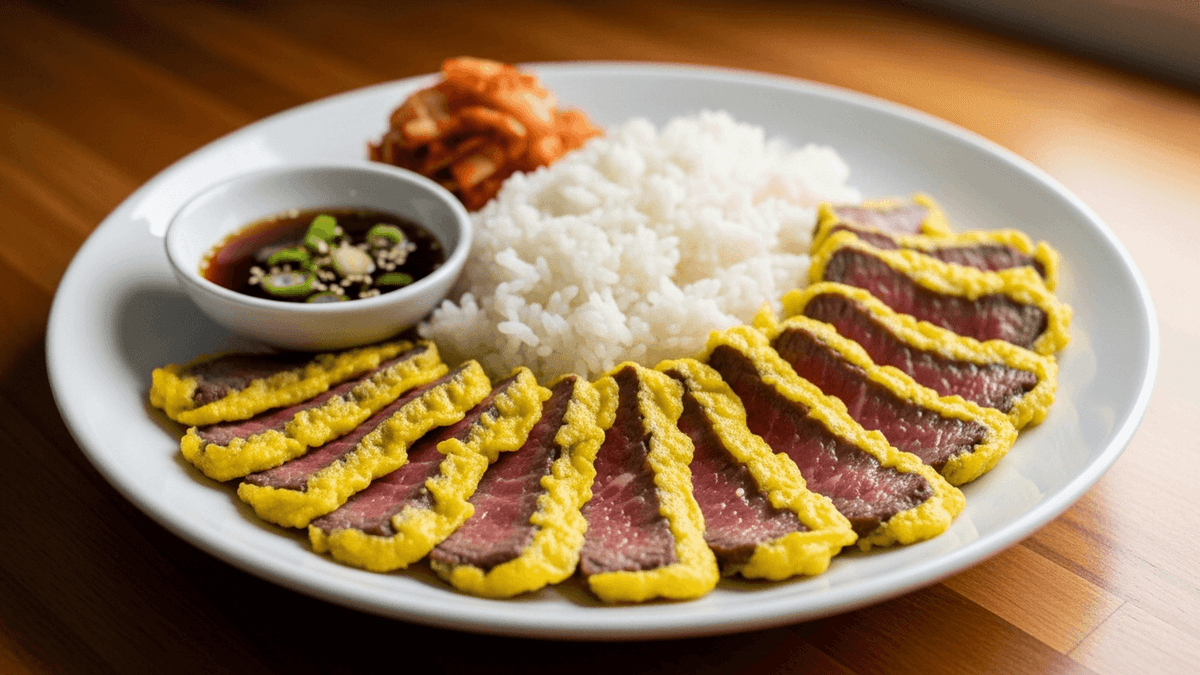
The standard Hawaii Korean plate:

  • Two scoops of short-grain rice
  • A pile of meat jun, fanned so the egg-gold and dark beef edges show
  • A small mound of kim chi
  • A ramekin of the dipping sauce
  • A scoop of Hawaiian mac salad if you are running the full plate lunch

The traditional Hawaii Korean BBQ plate is "meat jun and kalbi" together — both proteins on the same plate with rice and kim chi. That is the move if you are cooking for a hungry table. See the kalbi short ribs recipe for the second protein, and the plate lunch guide for the full format.

Make ahead and reheat

Marinate the beef up to a day ahead and keep it refrigerated. The pan-fry step is best done right before serving — reheated meat jun loses its texture and the egg coating turns rubbery. If you have to reheat, use a hot dry skillet for 30 seconds per side and serve immediately. Do not microwave it. Leftover marinated but un-fried beef freezes fine for up to a month; defrost in the fridge before cooking.

For the broader Korean-Hawaiian food context and how Korean immigration shaped Hawaii plate lunch, see the Hawaii plate lunch guide. For a sibling breaded-protein in the same weeknight category, see chicken katsu.
Recipe

Ingredients
  • 1.5 lb thin-sliced beef (ribeye, sirloin, or flank, sliced 1/8 inch thick — buy shabu-shabu or bulgogi cut from an Asian market)
  • 1/3 cup shoyu (soy sauce)
  • 2 Tbsp brown sugar
  • 2 Tbsp toasted sesame oil
  • 3 cloves garlic, minced
  • 1 Tbsp fresh ginger, grated
  • 3 green onions, thinly sliced
  • 1/2 tsp black pepper, freshly ground
  • 1 Tbsp mirin (optional, for rounder sweetness)
  • 4 large eggs
  • 1/4 cup all-purpose flour (optional, for a light dust before the egg)
  • 1/4 cup vegetable oil, for pan-frying
  • 3 Tbsp shoyu (for dipping sauce)
  • 1 Tbsp rice vinegar (for dipping sauce)
  • 1 tsp sesame oil (for dipping sauce)
  • 1/2 tsp gochugaru or crushed red pepper flakes
Instructions
  1. 01If the beef is not already sliced, freeze it for 20 to 30 minutes and then slice against the grain into 1/8-inch strips. The goal is paper-thin — thicker slices will not cook through in the pan-fry step. The easier move is to buy pre-sliced bulgogi or shabu-shabu beef from any Asian market.
  2. 02Whisk the shoyu, brown sugar, sesame oil, garlic, ginger, 2 sliced green onions, black pepper, and optional mirin together in a wide dish. Lay the beef in a single layer, flip to coat, then stack and refrigerate for at least 2 hours, ideally 4 to 6. Longer than overnight and the beef starts breaking down too much.
  3. 03Beat the eggs in a wide shallow bowl. If using flour, spread it in a separate plate.
  4. 04Heat a thin layer of vegetable oil (about 1/8 inch deep) in a skillet over medium heat. The oil is ready when a drop of egg sizzles immediately without browning instantly.
  5. 05Working a few slices at a time, shake off excess marinade, dredge each slice in flour (optional but gives a slightly crisper finish), shake off the excess, then dip in beaten egg to coat fully. Let the excess egg drip back into the bowl.
  6. 06Lay the egg-coated slices in the pan without crowding. Cook 30 to 45 seconds per side, until the egg coating sets and turns pale gold. The beef cooks through quickly because it is thin. Do not overcook — meat jun should stay tender.
  7. 07Transfer the finished slices to a paper-towel-lined plate to drain. Wipe the pan between batches if the oil darkens. Repeat until all the beef is cooked.
  8. 08Make the dipping sauce: whisk 3 Tbsp shoyu, 1 Tbsp rice vinegar, 1 tsp sesame oil, the last sliced green onion, and the gochugaru in a small bowl.
  9. 09Serve hot, fanned on a plate with the dipping sauce, two scoops of white rice, and kim chi. Add mac salad and kalbi if you are building the full Korean-Hawaiian plate lunch.

Prep
15 min
Cook
20 min
Total
35 min
Yield
4 servings

Quick answers

What does "jun" mean?

Jun (also spelled jeon in standard Korean romanization) is the Korean word for foods that are pan-fried with an egg batter, flour batter, or both. The category includes pajeon (scallion pancakes), kimchijeon (kimchi pancakes), and various meat and fish juns. Hawaii's meat jun is specifically the beef version.

What cut of beef is best for meat jun?

Ribeye or sirloin, sliced paper-thin against the grain. Flank or top round also work if sliced thin enough. The goal is beef that cooks through in 30 to 45 seconds per side. Buying pre-sliced bulgogi or shabu-shabu beef from an Asian market is faster than slicing it yourself and the texture is more consistent.

Do I need to flour the beef before dipping in egg?

No. The flour dredge is optional and gives the egg coating a little more grip and a slightly crisper finish. Plenty of Hawaii families skip it and go straight from marinade to egg. Either way works — it is a texture preference, not a structural requirement.

Is meat jun the same as bulgogi?

No. Bulgogi uses a similar marinade but the beef is grilled or stir-fried with no egg coating. Meat jun is specifically the egg-battered pan-fried variant that Hawaii Korean households developed alongside the broader plate lunch format. You can use the same marinated beef for either dish — the technique is what makes it meat jun.

Where can I find meat jun outside Hawaii?

Mainly in Hawaii. A few Hawaii-Korean BBQ spots that opened in California, Nevada, and Washington have carried meat jun forward, but it is rare on mainland Korean restaurant menus because it was developed in Hawaii rather than in Korea. Making it at home is the most reliable way to eat it outside the islands.

The Friday Letter

One recipe a week. No filler, no affiliate spam.

CurtisJ's kitchen notes in your inbox every Friday.

Unsubscribe any time. One email a week, never more.

CurtisJ